Farm Animals

CHICKENS 

4-2-03 036.jpg (91066 bytes)  

Chickens of 2009  

 Peyton is a Brahma Bantam rooster.  He likes to explore the farm most of day. He is very friendly.  

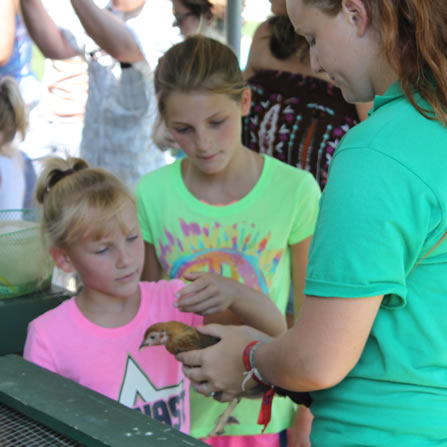
Harriett is a Partridge Wyandotte. Her feathers are similar to the wild partridge. She likes to be held by the staff. She lays large brown eggs. 

Ricky is a Buff Polish rooster. He has Poor eyesight because of his feathers and startles easily.  

Hester is a Golden Laced Wyandotte. She is very excitable. She lays large light brown eggs. Are her earlobes red? 

Della is a Delaware hen. These chickens  are named after the state from which they originated. She is very cautious and lays light brown eggs.  More red earlobes? 

Bernice and Mona are Brahma Hens.  They lay medium sized brown eggs. Brahmas have feathers on the outsides of their legs and on their feet.

    A male chicken is a rooster.

    A female chicken is a hen.

    A baby chicken is a chick.

    A group of chickens is called a flock.

It takes 21 days for a chick to hatch from an egg.

There are 113 different breeds of chickens.


  Some facts about chickens:

On average, 3 hens give you 2 eggs a day.  That means to get a dozen eggs a day, you would need 18 hens.

Most hens start to lay around 4-6 months of age.  However, for various reasons (time of year, temperature, etc.) they may wait until the next Spring to start laying eggs. 

You can tell what the color of the eggs will be by looking at the chickens earlobes. 

A white lobed hen will lay white eggs.

A red lobed hen will lay brown eggs.

The exception to this is the breeds Easter Egger, Ameraucana and Araucana breeds.  They normally have red ear lobes, but their eggs range from khaki green to sky blue to pink tinted to lavender tinted.


After the yolk is formed in the hen's single ovary, the yolk drops into the body cavity.  From there it goes into the infundibulum or "funnel".  It then starts it's way down the oviduct.  The oviduct is more than 2 feet long and it lined with glands that secrete the materials for the albumen (egg white), shell membrane and shell.  The egg pigment is added in the last staged of this process.  It takes 24 hours or more from the tome the yolk is released until the completed egg is laid.


A hen only needs a rooster in order to lay fertile eggs that could hatch.  A hen can lay non-fertile eggs without a rooster.


It is very difficult to tell roosters from hens at an early age.  In most breeds, cockerels (males) develop larger combs and wattles earlier than pullets (females) and start to crow at 16 weeks. 


There are many reasons why a rooster crows.  He could be announcing his territory, or letting the hens know he's there.  It can also be a challenge to another rooster.  Why they crow when they crow, only the rooster knows for sure.


Check out BarkYardChickens.com for more information. They are a wealth of information about raising chickens.